




Join us @diamondsfactoryworld




Pay directly when placing your order. No credit card number, no extra passwords, no worries.
Only pay for what you like. Review your order first and then decide what you want to keep.
Pay your orders in installments and at your own pace. You decide how much you want to pay monthly.
Klarna is one of the leading payment providers in Europe and a licensed bank that is fundamentally changing the payment experience for buyers and sellers. The company, founded in Sweden in 2005, enables online shoppers to handle outstanding payments immediately, later or in installments quickly, easily and securely. Klarna works with more than 130,000 retailers such as Asos, Spotify, MediaMarkt and Deutsche Bahn and currently employs more than 2,500 people in 14 countries. In 2014 Klarna took over Sofort GmbH; In 2017, Billpay GmbH was acquired. The company's investors include; Sequoia Capital, Bestseller Group, Atomico, VISA and Permira. More information can be found atwww.klarna.eu
Definitely! Shopping online couldn't be more secure than with Klarna. In a store, you can always touch and check the goods you want to buy before paying for them. We believe that online shopping should be no different. That's why Klarna purchase on account gives you the opportunity to check your goods first and pay later.
Our goal is to make shopping easier and safer - smooth. That is why we take drastic measures to protect you as a buyer against fraud and unreliable online retailers. Whenever you see the Klarna logo in an online store, you can be sure that the store is trustworthy and meets our strict requirements.
Klarna is also certified by TÜV Saarland and Trusted Shops. Certificates give you as a consumer positive indications of the quality of the services and products. The associations registered under "the TÜV" are known worldwide and the certificates promote the highest international reputation. TÜV Saarland has concentrated on customer-oriented services outside the traditional official fields of activity. Every year, TÜV Saarland ensures that our business model is serious and that Klarna offers secure payment methods through a detailed investigation.
Klarna has been a “Trusted Shops Authorized Partner” since 2011 and as an “authorized partner”, Klarna's processes are perfectly adapted to the Trusted Shops quality criteria. The Trusted Shops quality criteria are based on national and European laws that are important for online shopping. They take into account the current judgments and requirements of consumer protection organizations or go even further. Read more about the Trusted Shops seal of approval here.
In addition, Klarna Buyer Protection protects you with every purchase from Klarna. This is an agreement between you and Klarna that allows you to shop online safely. To ensure that the Buyer Protection Directive applies, you as a consumer must make the purchase from an entrepreneur. Please note that the Buyer Protection Directive only applies to payments made with Sofort if it is expressly stated on the payment method selection page in the merchant's online store.
Yes of course! You can chat with us in the app at any time or call us on 0221 669 501 10


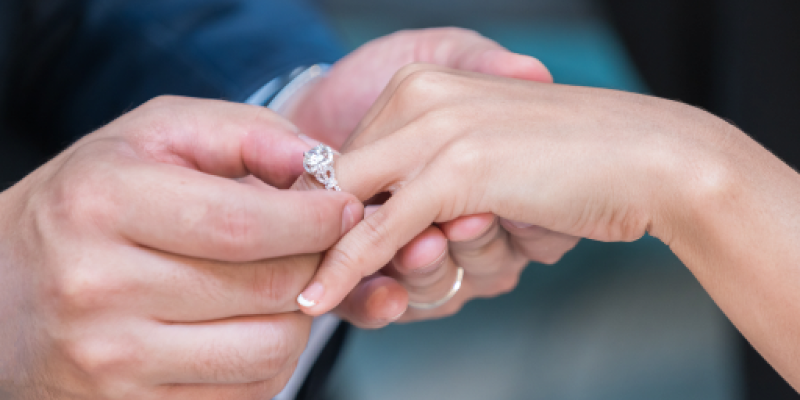
Today, proposing with a beautiful engagement ring is seen as one of the most romantic gestures, but did you know it hasn’t always been a way to symbolise love? In ancient times engagement rings were a sign of ownership, but luckily times have changed for the better. The history of engagement rings is an interesting one which we will discuss further in this article.
Where did the tradition of engagement rings come from?
The tradition of engagement rings stems from Ancient Rome - however, they did not have the same meaning as they do today. Throughout history, engagement rings have evolved and adopted the meaning that we know today - a proposition of marriage.
Ancient Rome: A Sign of Ownership
In Ancient Rome, engagement rings had a slightly different meaning - it was less about love and more about ownership. Roman women would often be given a ring made of ivory, flint, bone, copper or iron to symbolise a man’s ownership of them and as a sign of obedience. Some image-conscious women would be given two rings - a gold ring to be worn in public and an iron one for every day at home.
The Middle Ages: A Declaration of Intent to Marry
Throughout the Middle Ages is when the engagement ring started to develop popularity and a slightly different meaning. Around 850, Pope Nicholas I declared that engagement rings showed a man’s intent to marry. During this time, gold was the chosen material for engagement rings.
It is believed that diamond engagement rings originated in 1477 Vienna, when Archduke Maximillian of Austria commissioned a diamond engagement ring for Mary of Burgundy. As the wealthy travelled a lot, the tradition of diamond engagement rings spread to European aristocracy and nobility.
Victorian Times: Engagement Rings & the Industrial Revolution
In the Victorian era, engagement rings were still reserved for the upper class. With the industrial revolution and the discovery of diamond mines, jewellery production became a key focus, and the industry started to thrive.
During the Victorian era, dowries were the most popular way to secure engagement, so engagement rings tended to be on the simpler side - much like the solitaire engagement rings we see today.
20th Century: The Rise of Diamond Engagement Rings
After WW1, engagement ring sales declined and they became less relevant to the younger generation. Diamond prices collapsed, leading to De Beers creating their famous advertising campaign, in 1939, using the message ‘a diamond is forever’. The advertising campaign seemed to work and, by the early 1940s, engagement ring sales increased dramatically for jewellers and department stores worldwide.
Engagement rings were seen almost in the same way as a dowry. Until 1970, in the UK, women had the power to sue a man under ‘Breach of Promise’ if they decided to break off a marriage, whereas if women changed their mind there would be no penalty. This was probably because for most of the 20th Century middle and upper-class women would not work, and working-class women had to give up work when they got married. This meant that if the marriage or engagement ended, the woman could be left with nothing. For this reason, women could keep their engagement ring and sell it to live off the money.
While solitaire engagement rings have long been a popular choice, during the 20th Century other styles became sought after. For example, as demand was high, in the 1980s a surge of gemstone engagement rings came on the market to imitate Princess Diana's sapphire halo engagement ring. Other engagement ring styles looked to the past for inspiration, leading to more vintage style engagement rings on the market.
21st Century: A Time for New Traditions
Typically, the history of engagement has focussed on relationships between men and women. Since the beginning of the 21st Century, there have been reforms in the laws regarding same-sex marriage, which in turn may lead to new traditions forming. In recent years surprise proposals or planned proposals are normal and a lot of couples tend to have discussed a future together before getting engaged. These days, diamond rings aren’t reserved for getting engaged - they are also used as gifts, fashion jewellery and wedding rings.
Peruse our range of diamond engagement rings or head to our engagement ring and wedding ring resizing guide to learn more.